

Opening a book or a website and, without warning, seeing gruesome photographs of what a herpes outbreak looks like can be extremely upsetting, so you'll see no shocking photos of herpes here.
This not-so-unpleasant photograph of the Herpes Simplex Virus should be more than enough to help you identify whether what you are experiencing is herpes. It illustrates the various stages of blister formation. You can click on the image to enlarge it.
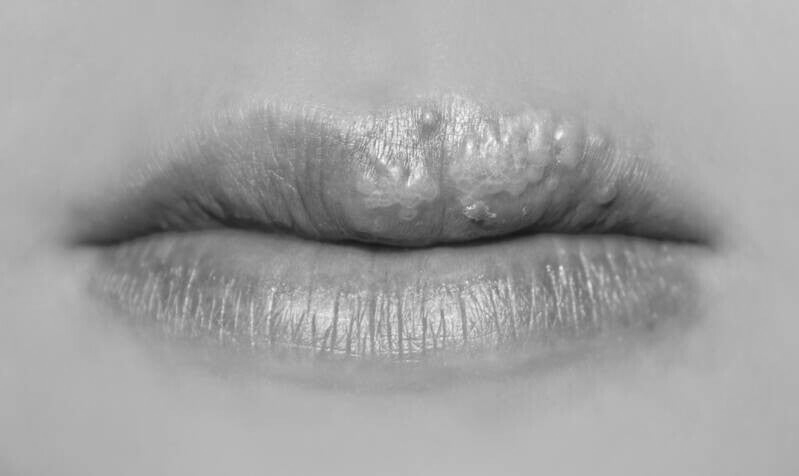
You'll see a firm-looking nodule at the very top of the lip. This nodule appears after the shedding stage (tingling, pain, or itch). To the very right of the upper lip, you'll see a nodule beginning to fill with fluid. The white patches represent a cluster of blisters that are starting to break open. The crusty-looking spot is a broken lesion drying and beginning to heal. Of course, you should always visit your care provider for a proper diagnosis.
Genital herpes (HSV-2) doesn't look any different than cold sores or Shingles, except that, because genital herpes often shows up in moist places, it may not have the opportunity to scab over. Instead, lesions remain soft and raw as they heal. However, depending on the exact location, it may or may not have the opportunity to dry and scab over. Lesions tend to stay soft and "craterish" throughout the healing process in moist areas.
Herpes can appear as only a single, small nodule (as shown above) or as several nodules. Nodules that are close together and form blisters can appear to be one large blister. Herpes can also appear as a pimple, a scratch, ingrown hair, razor burn, a red spot, hemorrhoids, a tiny, indented scrape, or an insect bite.
If you are curious, you can visit Google.com, click the word "Images" (in the top-right corner of the screen), and type in "Herpes Simplex Virus" to view images, but I don't recommend it. Some photos are practically obscene, certainly not images of average breakouts, and will scare you unnecessarily. You may lie awake at night wondering if that's going to be you, and it doesn't have to be. Not ever. If it has been you, it doesn't have to be you again.

Add comment
Comments